
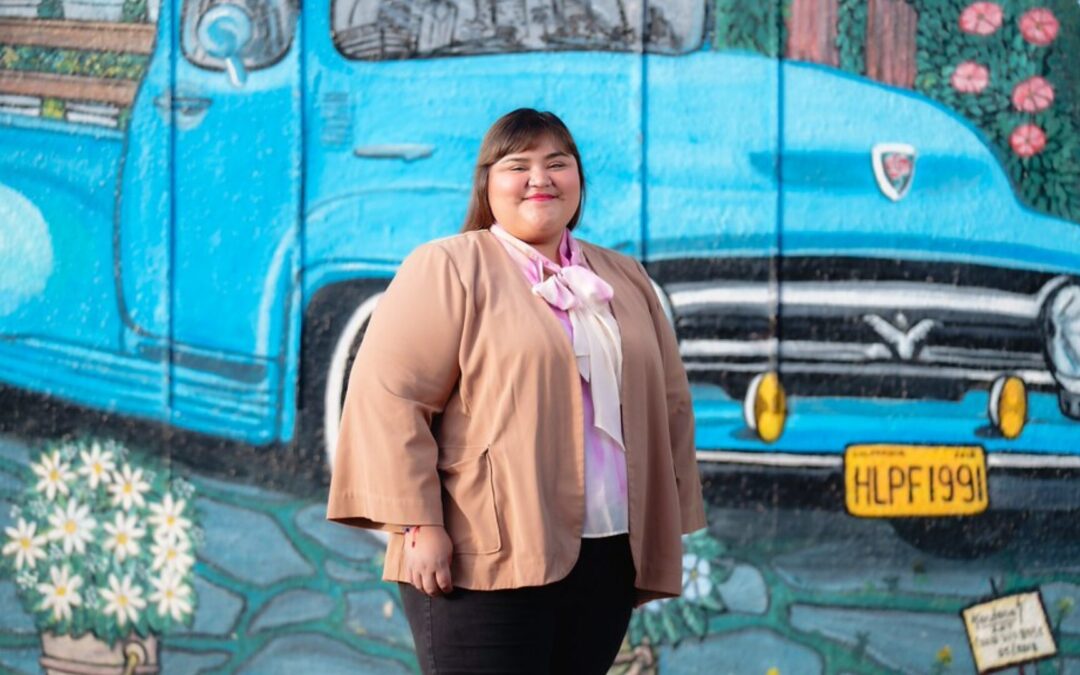
Eunisses Hernandez has quickly become one of the most recognizable voices in Los Angeles politics. The District One councilwoman has built a reputation for fighting for tenant protections, immigrant rights, and equitable investment in historically overlooked communities. But beyond City Hall debates and policy victories, Hernandez carries a deep connection to art. These cultural forces she believes are just as powerful as legislation when it comes to shaping communities and telling their stories.
A lifelong Highland Park resident and the daughter of Mexican immigrants, Hernandez grew up surrounded by the sounds and traditions that continue to inspire her today. From the classic voices of José José, Vicente Fernández, and Pedro Infante blasting through the house during her childhood, to the contemporary storytelling melodies of La Santa Cecilia and Natalia LaFourcade, music that has long been part of the rhythm of her life. Even in the middle of a demanding political career, she still turns to songs that ground her and reminds of heritage, resilience, and the generations that came before her.
In this conversation, Hernandez reflects on the cultural power of art and music during moments of social change. From supporting community-led projects like the Maya Corridor that celebrate Indigenous heritage, to amplifying Chicano artists who use their craft as a form of resistance. She sees creativity as a vital form of civic participation. For Hernandez, art does more than decorate a city, it documents history, inspires future generations, and reminds communities that their stories, sounds, and struggles deserve to be seen and heard.
FROM CITY HALL TO CULTURAL SPACES
We know you as the fierce councilwoman from LA’s District One, who formally designated LA a sanctuary city, who supports rent stabilized units, who fights against corruption and the transparent allocation of resources. But what is something many people might now know about Eunisses Hernandez?
I think one thing that people don’t know about me is that the one of the things that drives me so deeply to do this work is my loved ones and my friends that have been impacted by different systems. One of them being the carceral system and knowing that I have loved ones that haven’t been able to use their voice in these moments, that’s what drives me the most.
I do this work for my people. Because my people have been hurt, and harmed, and incarcerated, and I’m a survivor of sexual violence. That’s what drives my work. But I guess what people don’t know about me is that I’m just a simple person trying to do this work.
You supported the construction of the new Maya corridor which celebrates arts and legacy of the Mayan community. Why is it important for the community to celebrate indigenous people, to celebrate art, to celebrate that legacy?
Uplifting communities that have not been at the table, and whose voices have been left behind is one of my priorities.
When we think about the communities that have been impacted and who haven’t had the right space on the table, one of those groups is our indigenous communities. In my district I have whole neighborhoods where people are speaking just monolingual indigenous languages. The Mayan presence, the indigenous presence in our district, in this city, and in this region is so strong that I want to make sure that we can uplift these communities.
One of those ways is to name this corridor, the Mayan Corridor, to make sure that all the features are connected to the Mayan community. From the trees that are planted, to the paint color that we’re using. All of it is to make sure that people know that these communities are present, that they contribute a significant amount of culture and resources to the city of Los Angeles, that they are valuable, seen and respected.
This is a project where the people who are part of the Mayan community, part of the Guatemalan community, part of indigenous communities, all got together to say “this is what we want to see and this is the investment that we want”. And I’m just grateful.
You have also been a big advocate of using art as a way of protest, for example with the “Viva La Resistencia” gallery during Hispanic Heritage Month. Why is it important for artists to use their voice, their platform for good, especially during this difficult time.
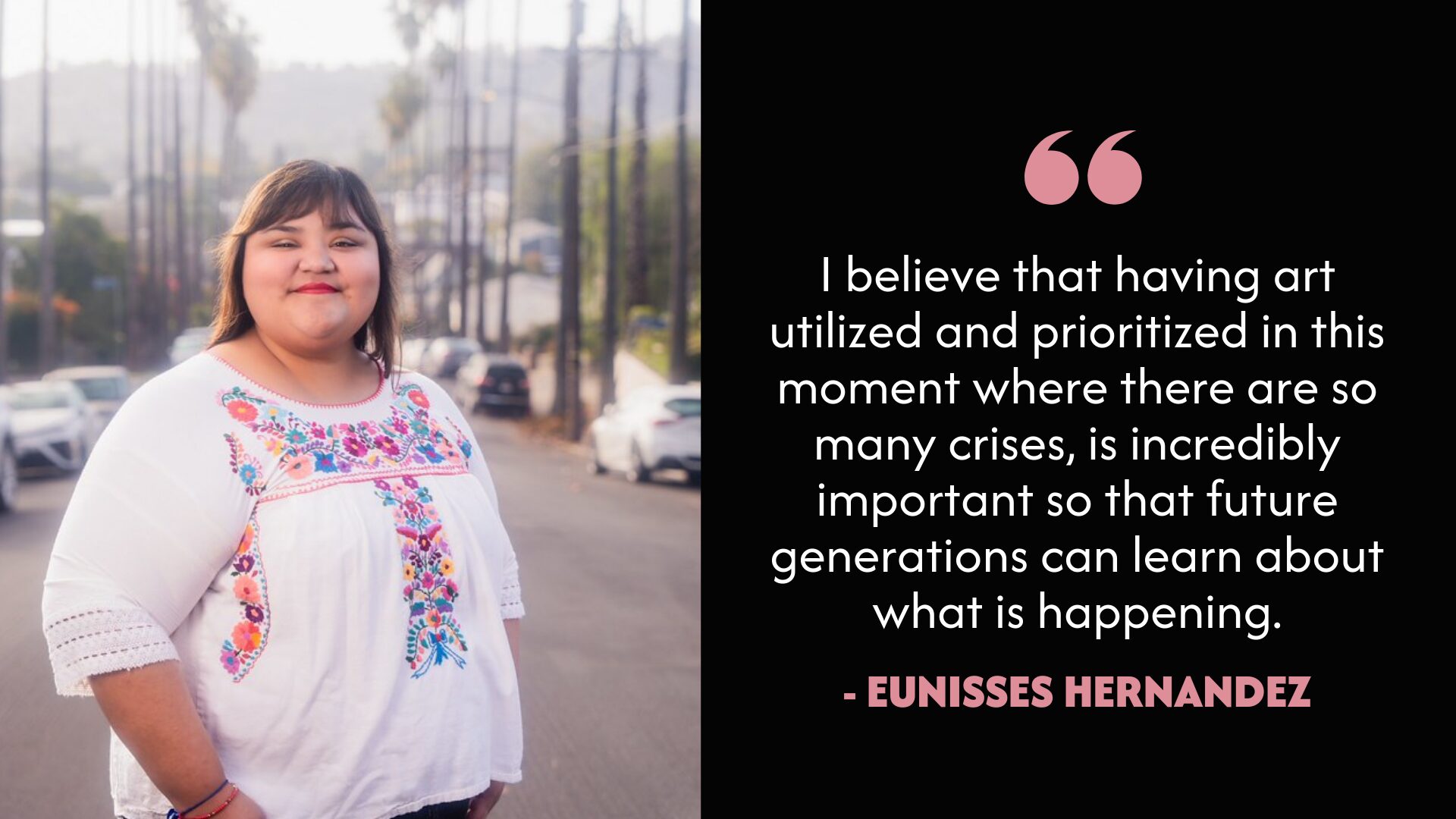
I believe that having art utilized and prioritized in this moment where there’s so many crises, is incredibly important so that future generations can learn about what is happening.
I think about all the art I saw about people protesting. The pictures, the photography, the paintings. I’ve had the privilege to witness other Chicano artists and Latino artists where their old art tells the story. Stories of when Latinos were being impacted by similar laws to the Jim Crow laws. It showed me the fights that were taken on in the past, where people were being brave.
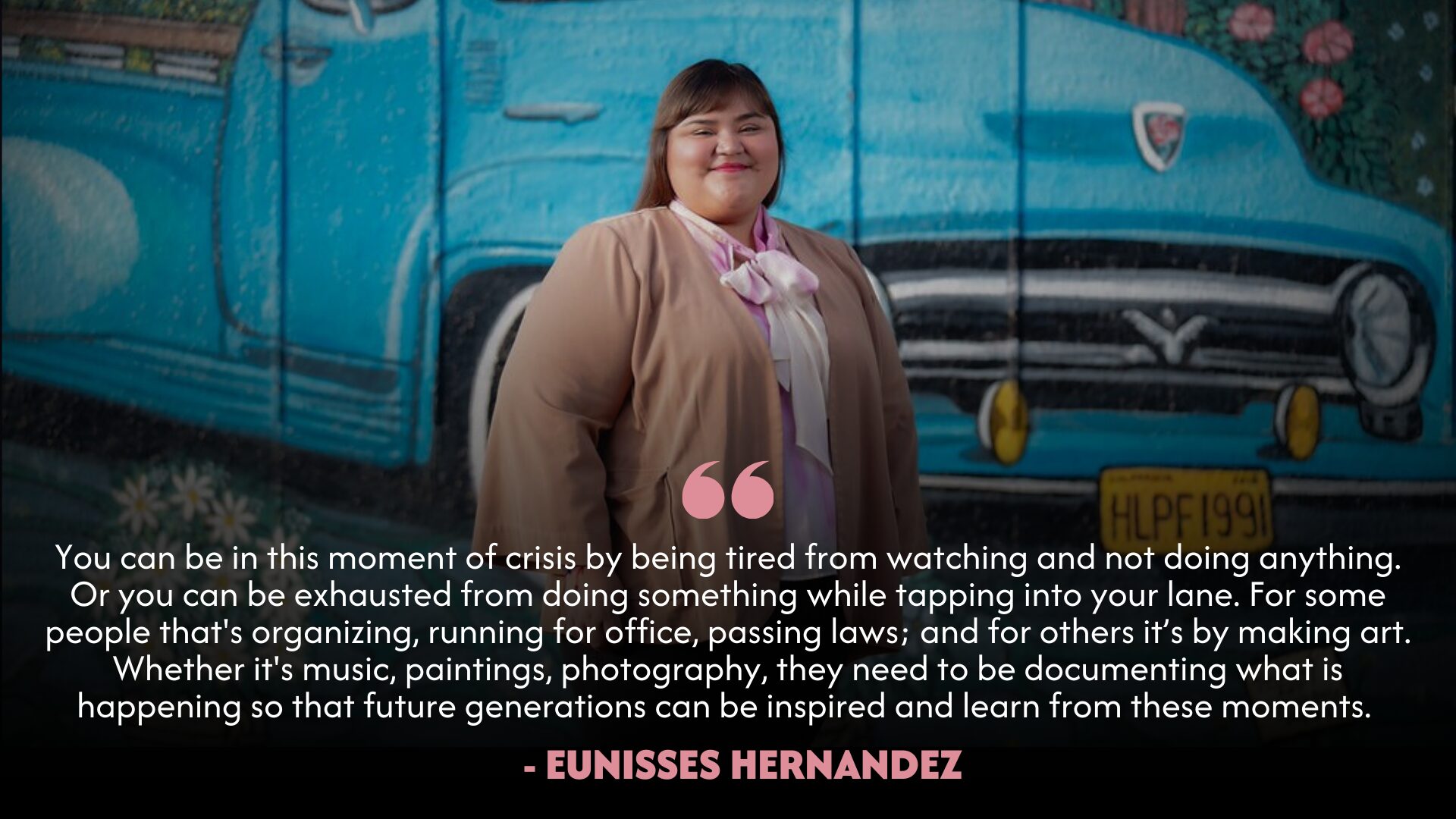
You can be in this moment of crisis by being tired from watching and not doing anything. Or you can be exhausted from doing something while tapping into your lane. For some people that’s organizing, running for office, passing laws; and for others it is by making art. Whether it’s music, whether it’s paintings, whether it’s photography, they need to be documenting what is happening now. So that future generations can also be inspired and also learn from these moments, and to be able to see ourselves in the warriors of the past.
We are celebrating women’s history month and I wanted to ask you, why do you think it’s important to have more women in positions of power?
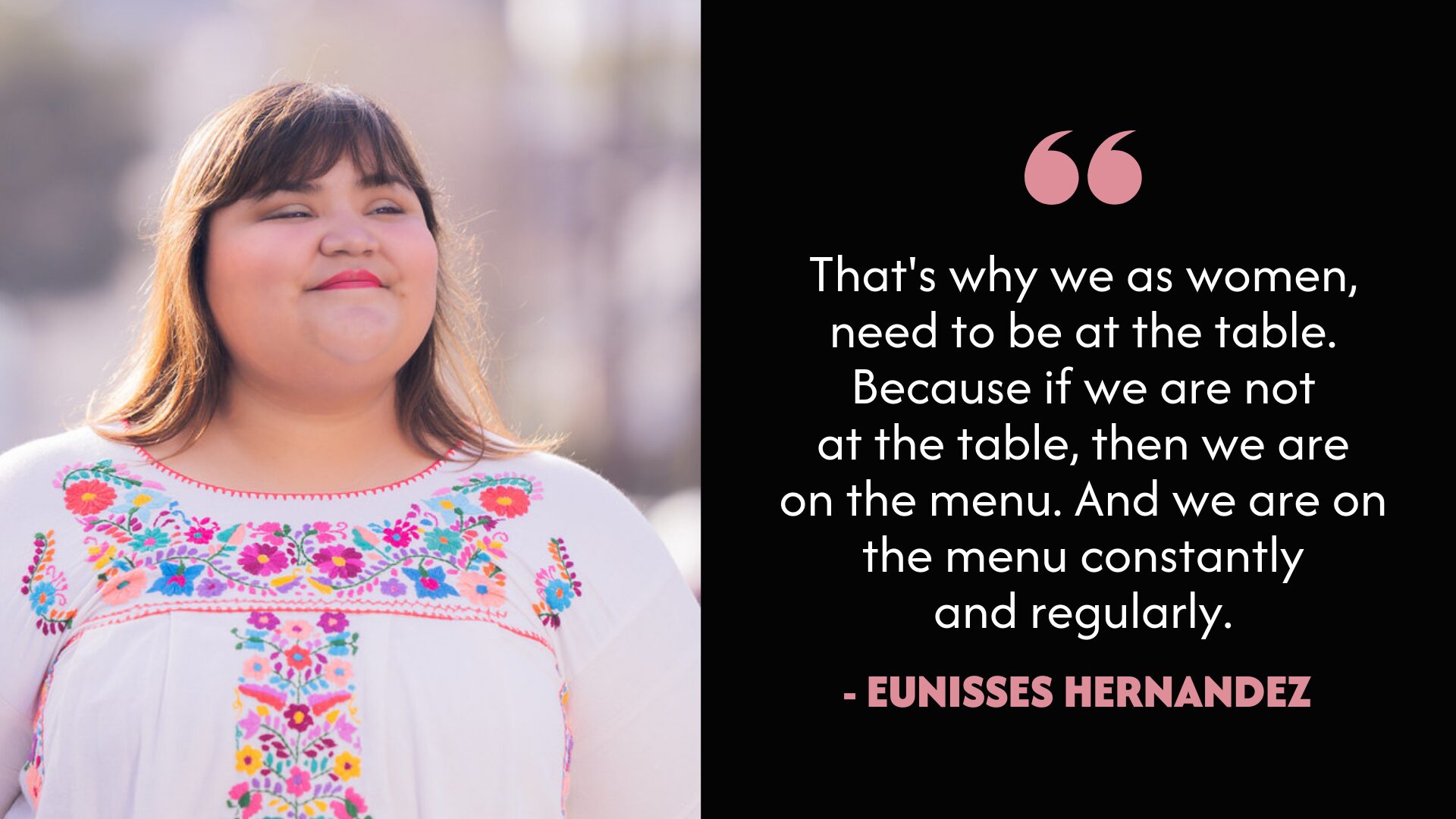
I believe that we need more women to run for office because we have different perspectives and we are on the receiving end of a lot of the harmful systems that exist. Whether it’s the Health Care System, the carceral system, particularly black women and black trans women. I believe that when more of us are at the table, better decisions can be made because of those experiences and because we have been impacted by these different systemic issues like the government trying to control our gender care or our reproductive care. That’s why we as women, need to be at the table. Because if we are not at the table, then we are on the menu. And we are on the menu constantly and regularly.
¿What can you tell us about your soundtrack? The music that inspired Eunisses Hernandez.
The music that inspires and that has inspired me has been on those weekends where your mom puts the music loud while cleaning and that oftentimes is José José, Banda music, Vicente Fernández, Pedro Infante and la Santa Cecilia.
That music is what speaks to my soul and even now i’m feeling very romántica. When I ran for office the first time, I listened to “Hasta la Raíz” a lot because I wanted to try to ground myself in a process that I was engaging in that wasn’t built for people like me. And it reminded me of ancestors, of the power of people and that helped me fill my soul. I’m also a nu metal fan, I love Korn and Limp Bizkit, Biskit.
¿Is there a particular lyric that has stayed with you or a song that places you in a better state of mind?
What’s in my head right now is “La nave del olvido. by José José. And that’s obviously a song about romance and heartbreak, but there’s a lyric that goes, “Espera un poco, un poquito más”, and for me sometimes it’s like, please have patience, we’re almost there. I sing that lyric to myself, to remind myself that we are almost there.
How have you seen the change after history was made at a Super Bowl with the first Latino like Bad Bunny and then adding the Villa tacos from your District during the game?
I first met Victor when he was still selling tacos from his family’s backyard, and people would line up outside his house buying them. Then, after a few years, they moved and bought a grill in Highland Park, and there would be a line of people buying Victor’s tacos. Then they were able to get enough money to open their first restaurant in my neighborhood, in Highland Park, at 55th Avenue and Figueroa. And to see him at the Super Bowl with Bad Bunny, who is literally breaking cement ceilings, and to bring not just him, just the Puerto Rican community, but different parts of the Latino community, and give him the opportunity. It’s like saying, “I’m going to eat, but you’re all going to eat with me, and we’re all going to eat and be here at this table.”
And I thought that was so beautiful. But it’s also something I’ve seen Bad Bunny do in different areas of his work, in his music, and also by pushing boundaries, gender roles, and masculinity. So, for me, it’s very much in line with how Bad Bunny has chosen to be, and for those of us who are paying attention, we understand that. But for the rest of the world, especially the world that watches the Super Bowl, it’s something they might be seeing for the first time, and it brings them a lot of joy.
It makes me very happy that Víctor is being recognized for his good work, that Bad Bunny made the table bigger and it gives me a lot of hope for what’s to come in the future, but also for what I hope people have learned.
UNITING VOICES OF RESISTANCE
Hernandez recently joined Adriana Ríos, a popular Regional Mexican music, and Corissa Hernandez, businesswoman and owner of Nativo Restaurant in Highland Park, for a Power Hour conversation celebrating Women’s Month. An evening that blended a live acoustic performance with an intimate dialogue about resilience, leadership, and using one’s voice to uplift others. Together, the event highlighted how music, storytelling, and shared experiences can inspire a new generation of women to lead with courage and community at the center.
To learn more about Eunisses Hernandez’s upcoming initiatives, cultural projects, and community programs across District 1, follow Eunisses Hernandez on her social media and digital channels for updates on events, collaborations, and opportunities to engage with the community.
Photo credit: Courtesy by Eunisses Hernandez team